The Volvo Parking Cooler offers no-idle cab cooling, reducing fuel use and boosting driver comfort
Volvo Parking Cooler Animation.mp4
Rest without the idle
When drivers park, the Volvo Parking Cooler keeps the interior cool while reducing idle time. The system uses deep-cycle AGM batteries and a 24-volt electrical architecture to provide up to 8 hours of consistent cooling, even in extreme heat.
The Volvo Parking Cooler: Built-in comfort
For drivers, the cab isn’t just a seat behind the wheel. It’s a workspace, a living space, and often, a place to rest. Comfort isn’t negotiable. It’s essential. That’s why the new Volvo VNL includes a fully integrated, battery-powered Parking Cooler.
“We designed the truck to have an integrated Parking Cooler from the start,” says Chris Stadler, Product Marketing Manager at Volvo Trucks North America. “It’s not just bolted on after the fact. That allows us to optimize everything: the placement of the system, the ducting, even the controls. It works better because it’s meant to be there.”
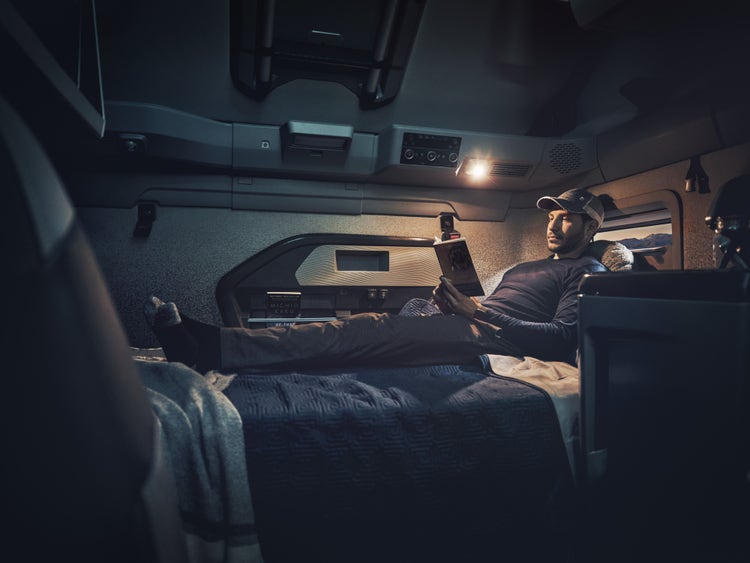
“This arrangement will keep a driver comfortable at 74 degrees for up to 8 hours—even in the hottest parts of the country. That means less idling, less fuel burn, and fewer emissions.”
It also supports a better rest environment. Key components like the condenser and fan move to the front of the truck. While the compressor moves to the frame rail. With these decisions, Volvo Trucks engineers dramatically reduced in-cab noise and vibration.
“Typically, with aftermarket APUs, you’ll have a fan running on the back of the cab all night,” Stadler explains. “That can be pretty disturbing when you’re trying to sleep. We took that noise away from the cab and put it where it won’t interfere with rest.”
Calculating the options
Choosing an integrated system like the Volvo Parking Cooler is about making smarter business decisions. Compared to engine idling or even an aftermarket APU, this solution delivers a significant reduction in fuel use and maintenance needs over the life of the truck.
“We ran the numbers using available data for an average long-haul VNL. With an engine averaging 81.5 operating hours a week, previously the idle time would be 40% of that, ” says Duane Tegels, also a Product Marketing Manager at Volvo Trucks. “In that situation, the total cost of operation with the integrated Parking Cooler came in just under $8,000. That’s more than $7,000 in savings compared to an APU, and over $10,000 compared to just letting the engine idle.”
The savings come from smarter energy use and lower upfront costs. While an APU might use slightly less fuel during rest breaks, it comes with a steep capital expense, $13,000 on average.
“Our system is built into the truck from day one, with an upfront cost closer to $4,000,” Tegels explains.

“When you combine that with reduced idle hours, less engine wear, and a quieter, more restful environment for the driver, the value of an integrated solution becomes clear.”
Integrated for simplicity
Inside the cab, the Parking Cooler is part of the same HVAC system drivers use every day. A single control panel operates the climate settings for both the driving and living space—no separate remotes or secondary units to manage.
“They don’t have to worry about multiple controls,” Stadler says. “Everything is integrated into one interface, which makes it easy to use and easy to trust.”
The system is also smart. If the batteries drop below a certain threshold, the truck’s automatic restart feature will kick in to maintain charge—protecting uptime and preventing roadside surprises.
A simple choice
For fleet managers, reduced idling means measurable savings in fuel and maintenance. For drivers, it means a more restful sleep and a better experience behind the wheel. “It’s not just a comfort feature,” Stadler says. “It’s a contributor to total cost of ownership and driver satisfaction.”